
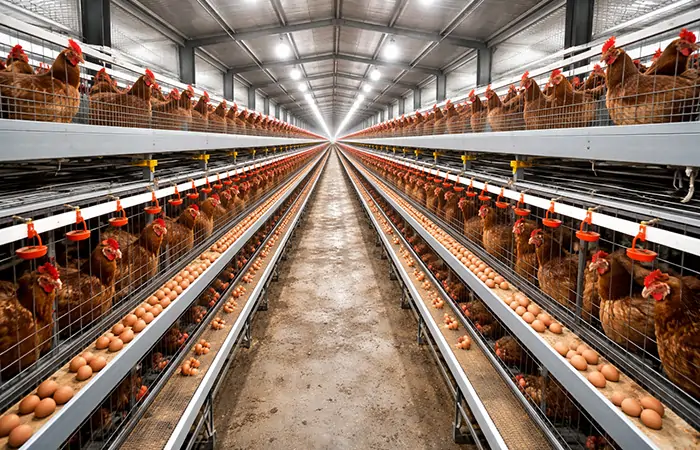
Layer chicken farming is the backbone of commercial egg production worldwide. For investors, farm owners, and agricultural suppliers, understanding how to raise high-performance layer hens is essential to building a profitable and scalable poultry operation. This comprehensive guide explains what layer chickens are, how modern layer poultry farms are designed, which equipment is required, and how to manage birds for maximum egg output from week 18 to week 80.
Table of Contents
ToggleWhat Is a Layer Chicken? (Layer Chicken Definition)
A layer chicken (also called a layer hen or egg layer) is a breed of poultry specifically developed for high egg production rather than meat yield.
Unlike broilers, layer birds are:
- Lightweight in body structure
- Highly feed-efficient for egg production
- Capable of laying 280–320 eggs per year under proper management
- Productive for a long laying cycle (up to 80 weeks)
Common commercial layer breeds include:
- Hy-Line Brown
- Lohmann Brown
- ISA Brown
These hybrid breeds are optimized for shell quality, laying persistence, and feed conversion.
Understanding Layer Chicken Farming and Poultry Production for Layers
Layer chicken farming is a specialized branch of poultry production focused entirely on consistent egg output, not meat growth.
Key production objectives in a layer poultry farm:
- High laying rate (>90% peak production)
- Low mortality (<5%)
- Efficient feed conversion
- Uniform egg size and strong shell quality
This differs from broiler farming in housing design, feeding strategy, lighting management, and farm layout.
Types of Layer Farming Systems
There are three primary systems used for raising egg layers:
1. Cage System (Most commercial farms)
- A-type and H-type layer cages
- High stocking efficiency
- Automated feeding, drinking, egg collection, manure removal
- Best for medium to large B2B farms
2. Deep Litter System
- Birds raised on floor with bedding
- Lower equipment cost
- Higher labor and hygiene challenges
3. Free-Range / Semi-Intensive
- Niche production model
- Not suitable for high-volume commercial egg supply
For commercial egg producers, the cage system remains the industry standard.
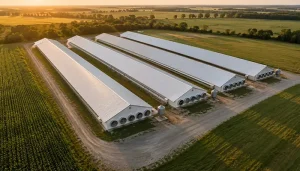
Layer Poultry Farm Layout and Housing Design
A scientific poultry house layout directly impacts egg production.
A proper layer poultry farm layout includes:
- East-west house orientation to reduce heat stress
- Controlled ventilation and airflow
- Even lighting distribution (16 hours/day during laying period)
- Cage row alignment for automation lines
- Manure pit or belt removal system
- Adequate spacing: 450–550 cm² per layer hen
A well-planned henhouse ensures lower stress, better hygiene, and higher laying performance.
Equipment Required for a Successful Layer Poultry Farm
Modern layer poultry production depends on automation and precision equipment:
- Layer chicken cage system (A or H type)
- Automatic feeding lines
- Nipple drinking system
- Automatic egg collection system
- Lighting control system
- Manure removal system
- Ventilation fans and cooling pads
These systems reduce labor costs while increasing production consistency.
Brooding and Growing Layer Chicks (Layers Chick Rearing)
Successful egg production begins during the chick stage.
Brooding (0–6 weeks)
- Starting temperature: 32–35°C, gradually reduced weekly
- 24-hour light for first week
- Vaccination schedule adherence
Growing Stage (7–16 weeks)
- Transition from starter to grower feed
- Weight uniformity is critical
- Prepare birds for transfer to laying house at week 16
Poor chick management leads to poor laying performance later.
Layer Chicken Feeding Program for Maximum Egg Production
Nutrition determines egg quantity and shell quality.
Feed stages:
- Starter feed (0–6 weeks)
- Grower feed (7–16 weeks)
- Layer feed (17 weeks onward)
A quality layer diet must contain:
- 16–18% protein
- High calcium (3.5–4%) for shell strength
- Balanced amino acids
- Clean water supply at all times
Average feed intake: 110–120 g per hen per day during peak laying.
Layer Breeding and Selection
Selecting the right layer breed is fundamental for profitability.
Productive layer hens show:
- Bright red comb
- Active behavior
- Good body weight uniformity
- Strong appetite
- Early onset of laying (18 weeks)
Hybrid commercial breeds outperform local birds in egg production efficiency.
Daily Management Practices in Layer Chicken Farming
Daily routines determine long-term productivity.
- Maintain 16 hours of light daily
- Collect eggs 3–4 times per day
- Monitor feed and water lines
- Remove weak or sick birds
- Maintain strict hygiene
- Keep production records
Consistency prevents production drops.
Common Problems in Layer Farming and How to Solve Them
| Problem | Cause | Solution |
|---|---|---|
| Drop in egg production | Lighting, stress, nutrition | Adjust light, improve feed |
| Soft shell eggs | Calcium deficiency | Increase calcium level |
| Pecking & cannibalism | Overcrowding, light intensity | Reduce density, adjust lighting |
| Disease outbreak | Poor hygiene | Vaccination, sanitation |
| Heat stress | Poor ventilation | Cooling pads, fans |
Layer Chicken Production Performance Benchmarks
A well-managed layer farm should achieve:
- 280–320 eggs per hen per cycle
- Peak production at 26–30 weeks
- <5% mortality
- Feed conversion ~2.1 kg feed per dozen eggs
Culling is typically done at 75–80 weeks.
Layer Chicken Production Performance Benchmarks
A well-managed layer farm should achieve:
- 280–320 eggs per hen per cycle
- Peak production at 26–30 weeks
- <5% mortality
- Feed conversion ~2.1 kg feed per dozen eggs
Culling is typically done at 75–80 weeks.
Broiler vs Layer: Understanding the Critical Differences
| Factor | Layer Chicken | Broiler Chicken |
|---|---|---|
| Purpose | Eggs | Meat |
| Body weight | Light | Heavy |
| Feed type | Calcium rich | Protein rich |
| Farming cycle | 80 weeks | 6 weeks |
Is Layer Chicken Farming Profitable? (B2B Perspective)
Layer farming is capital-intensive but highly profitable when automated.
Major costs:
- Cage and equipment investment
- Day-old chicks
- Feed cost (60–70% of expense)
- Labor and electricity
Revenue:
- Daily egg sales
- Manure by-product as fertilizer
- Spent hen sales after 80 weeks
Large farms achieve faster ROI through automation and scale.
Conclusion: Building an Efficient Layer Poultry Farm for Long-Term Egg Production
Raising layer chickens successfully requires:
- Scientific housing design
- Proper cage and equipment systems
- Correct nutrition and lighting
- Strict daily management
- Careful breed selection
For commercial egg producers, investing in professional layer poultry systems is the key to consistent production, lower mortality, and higher profitability over the long laying cycle.
 EN
EN  ES
ES  FR
FR  AR
AR  PT
PT  DE
DE