
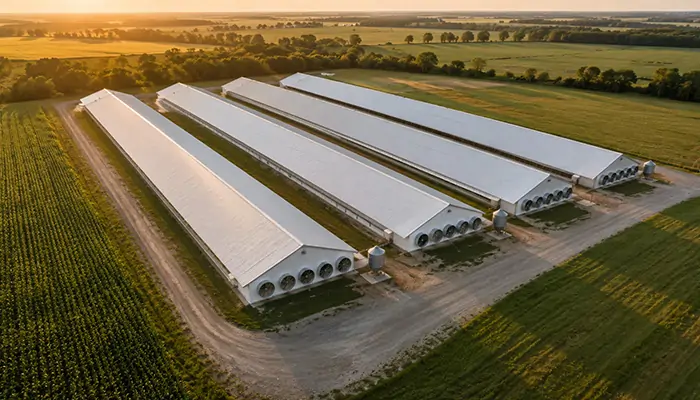
The U.S. poultry industry generates over $65 billion in output annually and employs more than 300,000 workers — yet it remains one of the few agricultural sectors where a first-generation farmer can reach commercial scale within three to five years. That is not an accident. It is the result of a relatively low biological cycle (broilers reach market weight in 47 days), a well-developed contract-grower infrastructure, and steady consumer demand that has only grown with the global protein shift.
But here is the part most beginner guides leave out: the farms that fail are rarely undercapitalized. They are underprepared. They misread the difference between backyard chicken-keeping and commercial poultry production, choose the wrong farm model for their land and capital, or enter a contract without understanding the integrator’s performance benchmarks.
This guide is written for people who want to move past the basics. Whether you are exploring egg poultry farming, broiler production, or country chicken rearing, you will find actionable steps, honest cost figures, and the industry-specific perspective that only comes from working in this field — not just writing about it.
What This Guide Covers
Types of poultry farming systems • U.S. industry structure • Step-by-step startup checklist • Egg vs. meat model comparison • Realistic cost and revenue data • Farm management essentials • How to become a contract grower • FAQ
1. What Is Poultry Farming? Definitions and Systems
Poultry farming — also called poultry husbandry or poultry rearing — is the raising of domesticated birds for meat, eggs, or both. In commercial contexts, ‘poultry’ almost always means chickens, but the category includes turkeys, ducks, geese, and quail.
The word is deceptively simple. What it describes ranges from a backyard flock of 20 hens to a contract broiler operation running 500,000 birds per cycle. Understanding where you fit in that spectrum is the first decision you need to make.
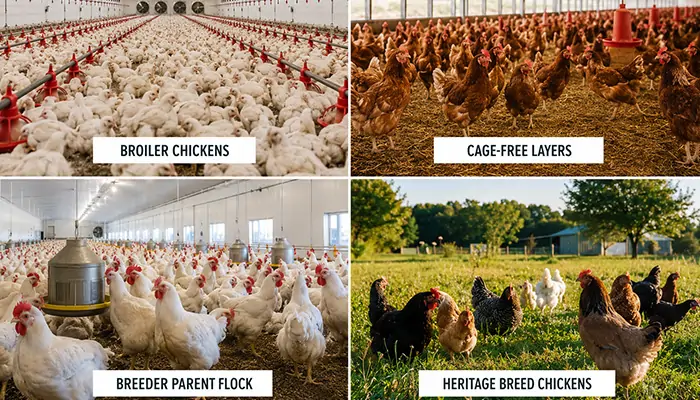
Types of Poultry Farming
There are four primary production types, each with distinct infrastructure, cash-flow timing, and market requirements:
- Broiler (meat) farming: Chickens are raised from day-old chicks to market weight, typically 5–6 lbs, in 6–7 weeks. High throughput, 5–6 flocks per year. Capital-intensive housing but relatively predictable revenue.
- Layer (egg) farming: Hens are kept for egg production over an 18–24-month laying cycle. Revenue is daily and consistent, but the flock replacement cycle adds cost complexity.
- Breeder farming: Raises parent stock that produces fertilized eggs for hatcheries. Higher biosecurity requirements, longer production cycles, and typically only available through integrator partnerships.
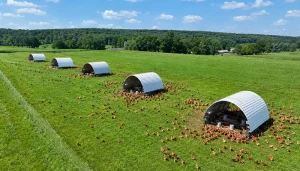
- Backyard / country chicken farming: Small-scale, often free-range, serving premium local or ethnic markets. Margins can be excellent; scalability is limited.
Poultry Farming Systems
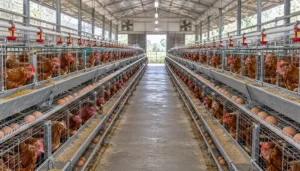
Within each production type, how chickens are raised determines both your cost structure and your market positioning:
| System | Stocking Density | Key Advantage | Best For |
| Conventional / Confined | High (5–8 birds/m²) | Lowest cost per bird | High-volume contract growing |
| Cage-Free | Medium (indoor, floor-based) | Access to premium retail buyers | Layer eggs, mid-scale |
| Free-Range | Low (outdoor access required) | Premium pricing, direct-to-consumer | Country chicken, specialty eggs |
| Organic | Very low (certified) | Highest retail price point | Premium egg or meat brands |
The industry insight here: most ‘premium’ labels (cage-free, free-range, organic) command 30–90% price premiums at retail, but they also carry significantly higher feed costs, lower productivity per square foot, and stricter certification requirements. Do not chase the label — chase the margin.
2. Poultry Farming in the USA — Industry Structure You Need to Understand
The U.S. is the world’s largest broiler producer and second-largest egg producer. But what makes American poultry farming distinctive is its vertical integration model — and if you do not understand this model before you invest, you risk building the wrong kind of farm entirely.
The Integrator System
In broiler production, roughly 97% of U.S. commercial chicken farms operate under contract with an integrator — companies like Tyson, Perdue, Koch Foods, and Mountaire Farms. The integrator owns the chicks, feed, and processing plants. The grower provides the land, housing, labor, and utilities.
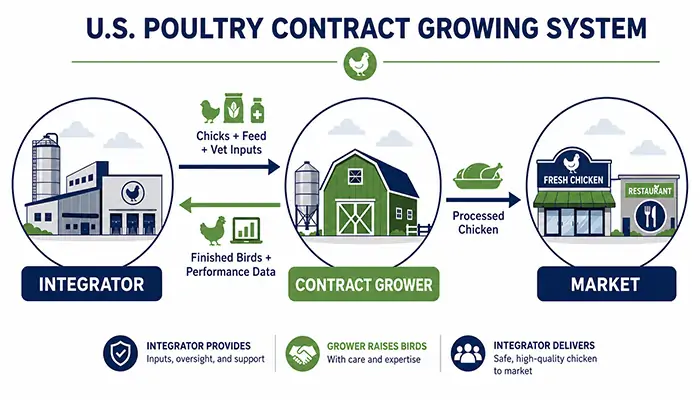
This is not a franchise. It is a service contract. The grower earns a ‘grow-out fee’ based on feed-conversion efficiency relative to other growers in their flock settlement group. Top performers earn bonuses; underperformers earn less. Understanding this tournament-style pay system is essential before signing any contract.
Key Insight: The Integrator Model Is Not Passive Income
Many prospective growers underestimate the operational intensity of contract farming. You are not renting space to a company — you are running a precision livestock operation to someone else’s specifications. Your profitability depends on your ability to hit FCR (feed conversion ratio), mortality rate, and live weight targets consistently, flock after flock.
Scale of the U.S. Industry
As of 2024, the United States has approximately 25,000 commercial broiler farms and 8,000+ commercial egg operations. A standard commercial chicken house holds between 20,000 and 50,000 birds. Larger operations run multiple houses on one site, with some facilities exceeding 500,000 total capacity.
For new entrants, the practical entry point for a contract broiler operation is typically 2–4 houses (80,000–200,000 birds), requiring $800,000 to $2.5 million in capital investment depending on land, location, and house specifications.
Independent vs. Contract Operations
A small but growing segment of growers operates independently, selling direct to restaurants, processors, or farmers markets. Independent operations require more marketing effort and carry market-price risk, but they also capture the full margin and are not subject to integrator performance benchmarks. This path is most viable for:
- Pastured or free-range broilers priced at $4–8/lb live weight
- Specialty egg production (heritage breeds, omega-3 enriched)
- Country chicken or ethnic-market breeds with premium local demand
3. When Is the Right Time to Start a Poultry Farm?
Timing matters more in poultry than in most livestock sectors because of the capital intensity. Unlike cattle ranching, where you can start small and scale organically, poultry farming has a minimum viable scale — below it, fixed costs make the business unviable.
The Readiness Checklist
Before committing capital, verify you can check every box below:
- Land secured: Minimum 5–10 acres for a 2-house operation, with appropriate zoning and 500-ft setbacks from residential areas in most states.
- Capital available: 20–30% equity stake minimum; most lenders (USDA FSA, Farm Credit) require this for poultry loan approvals.
- Integrator relationship confirmed: For contract growing, a signed or near-signed contract should precede construction — banks require it for financing.
- Water and power capacity verified: Each house requires 3-phase power and high-capacity water lines. Utility upgrades can add $50,000–$150,000 to startup costs.
- Business plan complete: Including break-even analysis, worst-case flock performance scenario, and debt service coverage ratio.
Small Farm vs. Commercial Scale — Which to Start With
This is the question we hear most often, and the honest answer is: it depends on your capital and your risk tolerance, not on any romantic notion of ‘starting small and growing.’
A backyard or small poultry farm (under 1,000 birds) can be cash-flow positive quickly with the right direct-sales strategy, but it will never generate a full-time income at scale without growing into commercial territory. A commercial contract operation requires significant upfront investment but comes with a contracted revenue floor.
Our recommendation for most first-time operators: if you have less than $300,000 in capital, start with a small layer flock (500–2,000 hens) selling eggs directly to local buyers while you build relationships, knowledge, and credit history. If you have $800,000+, go directly to a 2-house contract broiler operation with an integrator.
4. How to Start a Poultry Farm — Step-by-Step
The following sequence reflects the actual order of operations for a commercially viable startup, not the idealized version you find in most beginner guides.
Step 1: Choose Your Production Model
Broiler or layer? Contract or independent? Your answer determines everything downstream: land requirements, housing specs, equipment, and financing options. Do not skip this step or treat it as obvious — many failed farms chose the wrong model for their specific location and capital situation.
Broilers are better for areas with strong integrator presence (Southeast, Mid-Atlantic, Midwest). Layers are better for areas with strong local egg demand or proximity to regional food distributors. Country chicken farming is best for operators near urban ethnic-food markets.
Step 2: Write a Poultry Farm Business Plan
A poultry farming project plan must include: startup costs (itemized), operating cost per flock, revenue projection at 75%, 90%, and 100% performance, debt service schedule, and a contingency fund of at least 10% of total construction cost. Lenders will require this. More importantly, the discipline of writing it will surface assumptions you have not yet tested.
Step 3: Secure Land and Permits
Poultry houses must comply with USDA and state agricultural zoning, environmental permits (nutrient management plans, stormwater), and county setback requirements. The permitting process alone can take 3–9 months. Start early. Do not purchase land without first confirming it is permittable for poultry.
Step 4: Build the Poultry Farm House
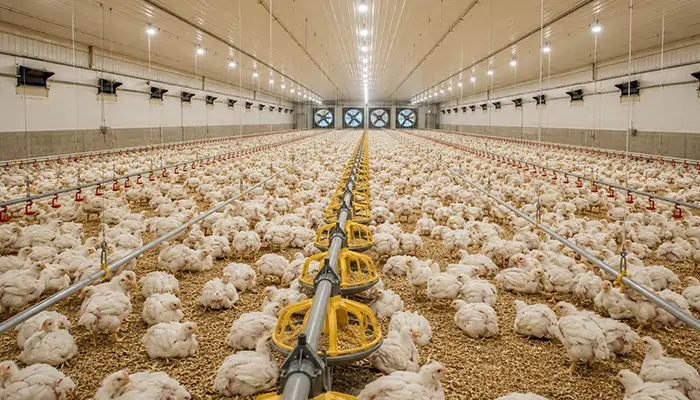
Modern commercial poultry farm house specifications are highly standardized, especially under integrator contracts. A typical broiler house is 40 ft x 500 ft (20,000 sq ft), tunnel-ventilated, with nipple drinkers, chain feeders, and automated climate controls. The building is not a barn — it is a precision-controlled environment.
Equipment Selection Matters More Than Most Growers Realize
Ventilation system performance directly determines your feed conversion ratio. Underinvesting in tunnel fans, evaporative cooling pads, or controller systems will cost you significantly more in poor FCR performance over the life of the operation than the upfront equipment savings. We supply the full range of commercial poultry house equipment — contact us for specifications and pricing.
Step 5: Source Chicks and Breeding Stock
Under a contract, the integrator delivers day-old chicks and you have no procurement role. For independent operations, source chicks from NPIP (National Poultry Improvement Plan) certified hatcheries only. This is not optional — NPIP certification ensures freedom from Pullorum disease and Typhoid, and most state regulations require it for commercial operations.
Step 6: Set Up Feed, Water, and Ventilation Systems
Feed accounts for 60–70% of total operating costs in broiler production. The feed system — bulk bins, auger delivery, pan feeders or chain feeders — must be sized correctly for your house length and bird density. Water system design (nipple drinker lines, pressure regulators, medicator ports) is equally critical. Mistakes here show up as inconsistent growth and elevated mortality within the first flock.
Step 7: Register with USDA and State Agriculture Agencies
All commercial poultry operations require registration with your state’s department of agriculture. USDA registration is required for interstate sales. NPIP participation is strongly recommended and required for most contract and sales arrangements. Your county extension agent can guide you through local requirements.
Step 8: Implement a Poultry Farm Management System
From day one, track daily mortality, feed consumption, water intake, and house temperature/humidity. These four metrics are your early warning system. A day-by-day flock log is not optional for contract growers — the integrator will review it at settlement. For independent operators, it is how you identify and correct problems before they compound.
5. Egg vs. Meat — Choosing the Right Poultry Business Model
This is one of the most consequential decisions a new poultry farmer makes, and it is made poorly far too often because the decision is driven by personal preference rather than market analysis. Here is the honest comparison:
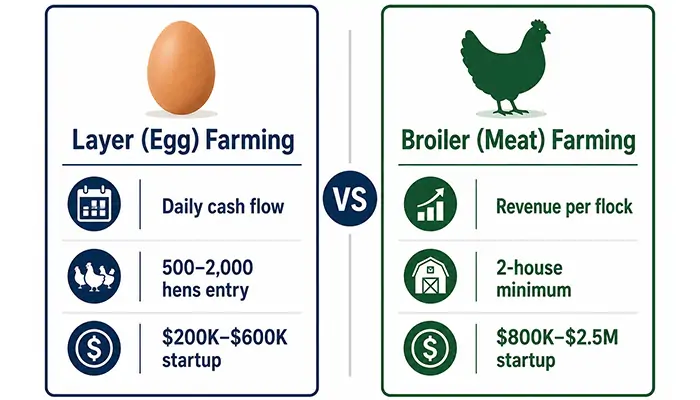
| Factor | Egg (Layer) Farming | Broiler (Meat) Farming |
| Startup Cost | $200K–$600K (2,000–10,000 hens) | $800K–$2.5M (2 houses) |
| Revenue Timing | Daily cash flow begins at ~18 weeks | Revenue per flock, every 8–9 weeks |
| Revenue Predictability | Moderate (egg price volatility) | High under contract, variable independent |
| Operating Complexity | Moderate (year-round flock management) | High (intensive 6-week grow-out cycles) |
| Labor Intensity | Moderate | High during placement and harvest |
| Waste Management | Manure ongoing | Litter between flocks (value as fertilizer) |
| Market Access | Local, regional, direct | Primarily through integrators |
| Best Entry Point | 500–2,000 hens, direct sales | 2-house contract with integrator |
Our perspective: layers are the better entry point for operators with less capital and a strong local food market. Broilers are the better path to scale if you are near an integrator and have the capital and temperament for high-throughput, high-intensity production.
One often-overlooked option: starting with a mixed operation (200–500 layers for cash flow + a small broiler rotation for volume) allows a new farmer to build operational skills while maintaining revenue across multiple streams. It adds complexity, but for the right operator, it is a faster path to profitability.
6. Poultry Farm Business Costs and Revenue — Realistic Numbers
The numbers below reflect 2024 U.S. market conditions. They are ranges, not guarantees. Your specific location, integrator contract terms, and management performance will determine where you land within these ranges.
Startup Costs — 2-House Broiler Operation
| Cost Item | Low Estimate | High Estimate | Notes |
| Land (5–10 acres) | $50,000 | $200,000 | Highly location-dependent |
| House Construction (x2) | $400,000 | $700,000 | Integrator specs required |
| Equipment (ventilation, feeders, drinkers) | $150,000 | $280,000 | Quality here is ROI-positive |
| Utilities Infrastructure | $30,000 | $150,000 | 3-phase power, water line upgrades |
| Permits & Engineering | $15,000 | $40,000 | Nutrient management plan included |
| Working Capital (first flock) | $30,000 | $60,000 | Utilities, litter, labor |
| Contingency (10%) | $67,500 | $143,000 | Non-negotiable in planning |
| TOTAL | $742,500 | $1,573,000 | Typical: $900K–$1.2M |
Revenue and Profitability
Under a typical integrator contract, a 2-house, 80,000-bird operation generates gross income of $180,000–$280,000 per year after the tournament payment adjustments, with net income after debt service of $40,000–$120,000 depending on performance. Top-quartile growers can exceed these figures significantly.
For independent layer operations (5,000 hens, direct sales at $4–5/dozen), gross revenue is approximately $175,000–$218,000 per year with operating margins of 25–35% for well-managed operations.
Chicken farming for profit is genuinely achievable — but only for operators who treat it as a business, not a lifestyle. The farms that underperform consistently are the ones that underinvest in equipment, skip biosecurity protocols, or fail to track performance metrics.
7. How Chickens Are Raised — Daily Farm Operations
Poultry rearing is more demanding than most outsiders expect. Here is what the daily reality looks like for a commercial operation:
The Broiler Grow-Out Cycle
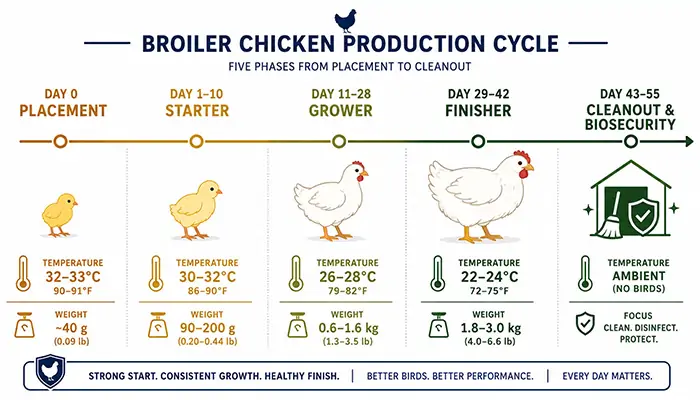
- Placement (Day 0): Day-old chicks are placed in a pre-warmed house (90°F). The first 72 hours are critical — chick placement quality determines much of your final performance.
- Starter Phase (Days 1–10): High-protein starter feed, supplemental heat, frequent inspection for mortality and uniformity. Target mortality: under 0.5%.
- Grower Phase (Days 11–28): Transition to grower feed, tunnel ventilation fully engaged in warm weather. Daily water consumption is your health monitor — a 10% drop is a red flag.
- Finisher Phase (Days 29–42): Birds approach market weight. Restrict feed per integrator protocol in final days. Prepare for live haul.
- Cleanout (Days 43–55): Remove litter, pressure-wash, disinfect, rest the house (minimum 14 days). This downtime is not wasted — it is your biosecurity investment.
Vaccination, Biosecurity, and Disease Prevention
Newcastle disease, Infectious Bronchitis, Marek’s disease, and Avian Influenza are the primary threats to commercial flocks. In the U.S., the HPAI (Highly Pathogenic Avian Influenza) outbreaks of 2022–2023 cost the industry over $3 billion and affected 57 million birds. Biosecurity is not a regulatory checkbox — it is a survival practice.
Minimum biosecurity requirements: perimeter fencing, controlled access with foot baths, dedicated farm clothing, rodent control program, and a written Biosecurity Plan filed with your state veterinarian. Contract integrators will audit this.
Feed and Water Management
Broiler feed conversion ratio (FCR) — the pounds of feed required to produce one pound of live weight — is the primary performance benchmark in the industry. Industry average is approximately 1.9:1. Top performers consistently achieve 1.7:1 or better. Each 0.1 point improvement in FCR on an 80,000-bird flock represents approximately $4,000–$6,000 in annual savings at current feed prices.
Water management is equally important but less discussed. Chickens consume roughly twice as much water as feed by weight. Nipple drinker pressure, cleanliness, and line flushing schedules directly affect water intake, which affects feed intake, which affects growth rate.
8. How to Become a Poultry Farmer — Career Paths and Next Steps
The Education Path
A formal agricultural education is not required to succeed in poultry farming, but it helps. USDA Agricultural Research Service, state land-grant universities (Auburn, Mississippi State, University of Delaware), and organizations like the National Chicken Council offer training programs ranging from free online resources to multi-day workshops.
The most valuable education, however, is working on an existing commercial farm for 6–12 months before investing your own capital. No textbook replaces the experience of managing a live flock through a heat event, a respiratory outbreak, or a feed system malfunction.
How to Become a Contract Poultry Grower
The path to a contract growing arrangement follows a predictable sequence:
- Identify integrators operating in your region. This is geography-limited — you need to be within 25–40 miles of a processing plant.
- Attend integrator open house events or contact their grower relations department directly. They are actively recruiting in most regions.
- Have your land and financing structure in place before serious conversations. Integrators do not want to wait 2 years for a grower to secure financing.
- Negotiate the contract with an agricultural attorney who has poultry contract experience. Do not sign alone.
- Build your houses to integrator specifications — deviations require approval and can void performance bonuses.
Associations and Networks
Joining the National Contract Poultry Growers Association (NCPGA), your state poultry association, and attending the International Poultry Expo (Atlanta, January) will accelerate your learning curve and give you access to supplier networks, legislative advocacy, and peer grower communities that are invaluable for new operators.
FAQ — Frequently Asked Questions About Poultry Farming
What is the difference between broiler and layer farming?
Broiler farming raises chickens for meat (market weight in 6–7 weeks). Layer farming raises hens specifically for egg production over an 18–24 month cycle. The housing, genetics, feed, and management systems are entirely different — they are not interchangeable.
How many chickens do I need to start a profitable farm?
For a commercially viable independent layer operation: minimum 500 hens for direct-sales profitability; 2,000+ hens for a full-time income. For contract broiler production: minimum 40,000 birds per house (2 houses recommended). Below these thresholds, fixed costs typically make profitability difficult without premium pricing strategies.
How much does it cost to start a poultry farm in the USA?
A small backyard or direct-sales operation (500–1,000 hens) can be started for $50,000–$150,000. A commercial contract broiler operation (2 houses) requires $800,000–$1.5 million. A mid-scale independent egg farm (5,000 hens, barn system) typically costs $350,000–$600,000.
Do I need a license to run a commercial chicken farm?
Yes. Commercial poultry operations require state agriculture department registration, NPIP certification for sales and transportation, a nutrient management permit in most states, and federal registration for interstate commerce. Specific requirements vary by state — contact your county extension office for the exact sequence in your jurisdiction.
What is a contract poultry grower?
A contract poultry grower provides land, housing, labor, and utilities in exchange for a grow-out fee from an integrator. The integrator owns the birds and controls feed, veterinary inputs, and chick delivery. Growers are paid based on performance benchmarks relative to other growers in the same flock settlement group. It is a service relationship, not an ownership model.
What is country chicken farming?
Country chicken farming refers to raising indigenous or dual-purpose breeds (often called desi chicken in South Asian markets) under free-range or semi-intensive conditions. In the U.S. context, it typically means heritage or specialty breeds sold to ethnic food markets, farm-to-table restaurants, or direct-to-consumer buyers. Slower growth rates and lower density mean higher cost per pound — but market prices of $5–12/lb make it commercially viable in the right locations.
Conclusion: The Most Important Decision Is the One You Make First
Starting a poultry farm is a capital-intensive, operationally demanding, and genuinely rewarding business — when entered with clarity. The farmers who succeed long-term are not the ones who move fastest. They are the ones who chose the right model for their location and capital, invested in quality infrastructure from the start, and treated farm management as a precision science, not a daily improvisation.
Whether you are evaluating a backyard egg operation or a two-house contract growing arrangement, the fundamentals are the same: know your costs before you commit, understand your market before you build, and never underinvest in the equipment that directly determines your production performance.
Ready to Take the Next Step?
We supply commercial-grade poultry house equipment — ventilation systems, automated feeders, nipple drinker lines, and environmental controllers — to growers across the United States. Contact our team for a free consultation and equipment specification for your planned operation.
 EN
EN  ES
ES  FR
FR  AR
AR  PT
PT  DE
DE