
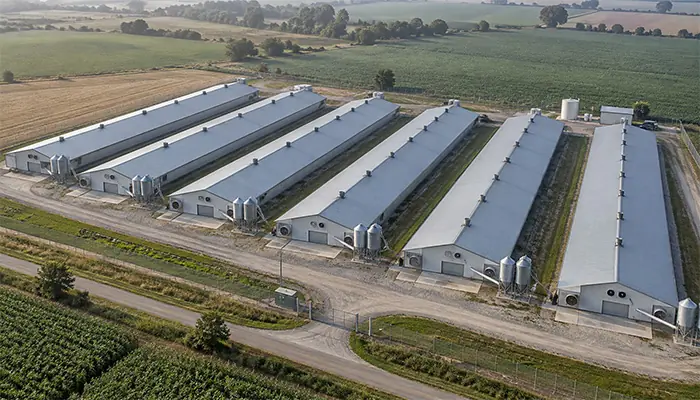
Chicken farms turn a daily routine of feeding, watering, environmental control and flock care into a supply of eggs or meat. Behind that routine are decisions about breeding, housing, staffing, equipment and what happens when something goes wrong.
Chicken farms operate by raising birds for a defined purpose and managing their needs throughout each production stage. Some farming practices cause serious welfare problems, including painful health conditions and restrictions on natural behaviour. The conditions in which birds live, and their actual health and behaviour, matter more than a farm’s size or a photograph of modern equipment.
Whether raising animals for food is morally acceptable is also an ethical question. Measuring welfare helps identify suffering and opportunities for improvement, but it does not settle every ethical objection. For poultry businesses, understanding both the production process and these concerns is essential when planning a farm or replacing equipment.
What Is Chicken Farming?
Chicken farming is the raising and management of chickens for meat, eggs or breeding. Chicken rearing describes the process of bringing birds through their growth stages, from chicks to the age appropriate for their production role.
Poultry farming is a broader term. It includes chickens and other domesticated birds, such as turkeys, ducks and geese. A chicken farm is therefore one type of poultry farm.
Commercial chicken farming usually involves specialised roles. One business may produce hatching eggs, another may hatch chicks, and another may raise birds for meat or table eggs. Some companies coordinate several stages, while independent farmers may purchase chicks, feed and services from outside suppliers.
This distinction matters when planning equipment. A hatchery, a broiler house and a laying house serve different purposes, even if all three belong to the same poultry company.
The business side also depends on these boundaries. A farmer may own the birds and purchase inputs directly, or work within a contract that divides responsibilities among several businesses. Before investing, establish who supplies chicks and feed, who provides technical support, who purchases the output and who carries the risk of interrupted production. These arrangements affect working capital and scheduling, even when the physical poultry houses look similar.
What Are the Main Types of Chicken Farms?
Broiler Farms for Chicken Meat Production
Broiler farms raise chickens for meat. Managers organise chick placement, feeding, housing and flock removal around a production cycle. The required market weight and the chosen strain influence that cycle; there is no single timetable that describes every meat chicken farm.

Layer Farms for Egg Production
Layer farms keep hens for table eggs. Young females, called pullets, are reared before entering the laying stage. Some farms rear their own pullets, while others purchase them. During production, work includes flock inspection, feed and water management, egg collection and planning replacement flocks.
Breeder Farms and Hatcheries
Breeder farms produce fertile eggs for hatching. Hatcheries incubate those eggs and supply chicks to other farms. Breeder management must account for reproduction as well as feeding, housing and health. When evaluating a sistema de alimentação em cadeia para reprodutores de piso, buyers should specify the breeder flock and ask how the layout will support feeding access and daily inspection.
| Farm type | Main output | Operational focus |
|---|---|---|
| Broiler farm | Birds for meat production | Rearing, growth, flock health and dispatch |
| Layer farm | Table eggs | Hen care, laying performance and egg handling |
| Breeder farm | Fertile hatching eggs | Breeding flock management and hatching egg quality |
| Hatchery | Pintos | Incubation, hygiene and chick handling |
How Do Chicken Farms Operate Step by Step?
1. Planning the Farm and Preparing the Poultry House
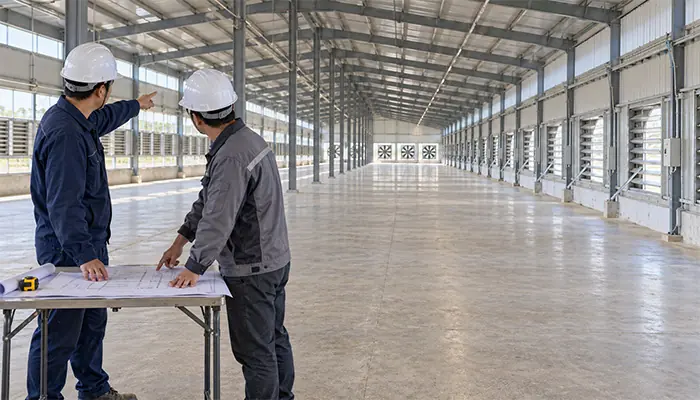
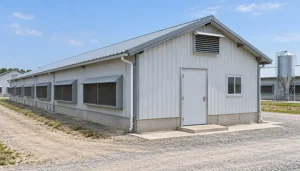
Planning begins with the bird type, intended output and market requirements. House dimensions, local climate, labour availability, water quality and electricity reliability then shape the equipment specification. Capacity should be checked against the whole building and its services, rather than calculated only from the number of cages or feeding positions.
Before placement, the team prepares the house, completes the cleaning programme and checks essential equipment. A written handover can confirm that drinking lines, feed delivery, heaters, fans and alarms are ready.
2. Sourcing Chicks and Managing Brooding
Chick placement connects the hatchery to the rearing operation. Farmers need clear delivery arrangements and information about the flock’s origin. Once chicks arrive, staff check their condition and access to feed, water and the prepared brooding environment.
Brooding settings should follow appropriate strain guidance and on-site observation. An equipment display cannot tell the whole story: staff also need to observe where chicks gather and whether they are reaching the resources provided.
3. Providing Feed and Clean Drinking Water
Feeding programmes change with the bird’s stage and purpose. Storage, delivery and access all matter. A full silo is of little help if feed fails to reach part of the house, and a working water supply does not guarantee that every drinker is functioning.
Automatic equipment can make delivery more consistent, but staff still need to check operation along the line. Consumption records are useful for spotting changes that require investigation.
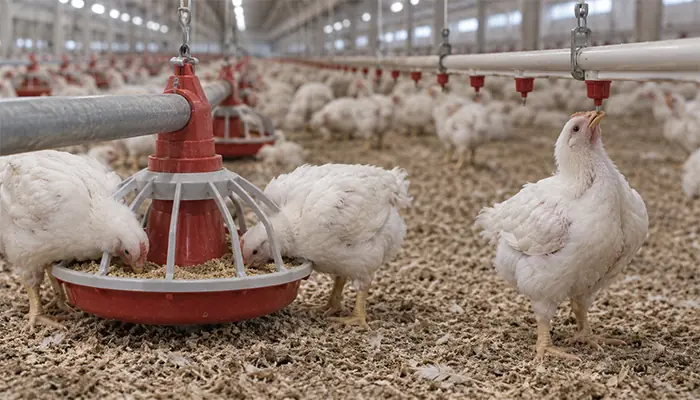
4. Controlling Ventilation, Temperature and Lighting
A poultry house must accommodate changing weather and the growing flock. Managers coordinate ventilation, heating or cooling and lighting with the production stage. Measurements should represent the birds’ environment, including locations that differ from the main controller’s position.
For a new project, ask who receives an alarm and how that person responds. Backup power and emergency arrangements should be practical for the site, with responsibilities assigned before birds arrive.

5. Monitoring Flock Health and Biosecurity
Daily inspection combines observation with records. Staff look for changes in activity, feeding, drinking and physical condition, then investigate unusual patterns. Veterinary support helps farms develop health plans appropriate to their circumstances.
Biosecurity addresses how people, vehicles, supplies and equipment move through the operation. The layout should make the planned cleaning and access routines possible during an ordinary working day, not only during an audit.
6. Managing Litter, Manure and Farm Hygiene
Manure management depends on the housing system. Floor-based houses require attention to the bedding and areas affected by leaking drinkers. Other layouts use manure collection or removal equipment beneath birds.
The work continues outside the house: collection, storage and further treatment need their own plan. When comparing proposals, identify who performs each task, how equipment is cleaned and how maintenance can be completed without disrupting essential flock care.
7. Collecting Eggs or Preparing Broilers for Transport
In a laying operation, eggs move from the house to collection, grading or packing arrangements. Farmers also check breakage and cleanliness to identify problems in handling or equipment adjustment.
In a broiler operation, the team coordinates flock removal with catching crews, transport and processing schedules. The farm and processing plant may be separate businesses. Clear communication is important at this handover because responsibility for the birds passes between teams.
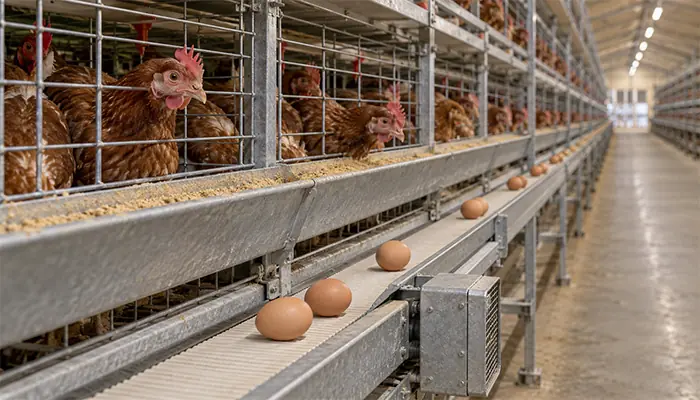
8. Cleaning Between Flocks and Reviewing Results
When a house is emptied between flocks, it provides an opportunity for cleaning, repairs and a review of the completed cycle. Recurring leaks, inaccessible inspection points or repeated alarms should feed into the next maintenance plan.
Review production and welfare records together while keeping their meanings distinct. Output, feed use and labour hours describe business performance; they do not, by themselves, describe the birds’ experience.
Which Chicken Farming Systems Are Used?
Farm type describes what is produced. Housing system describes where and how birds live. A commercial operation can be cage-free, and an indoor house does not necessarily contain cages. “Factory farming” commonly refers to intensive production, but it is not a precise description of one equipment design.
Indoor Floor and Deep-Litter Systems
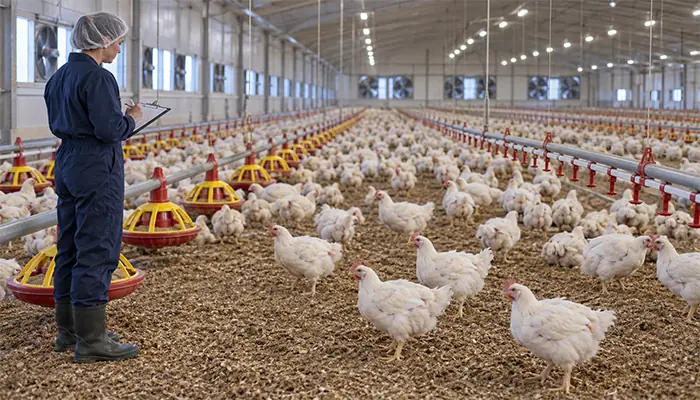
In floor systems, birds move around within the house. Litter provides a surface that must be managed throughout the flock cycle. Layout decisions include the positions of feeders, drinkers, service routes and, where appropriate, nests or raised areas.
A sistema de cama profunda para aves de capoeira should be evaluated as part of a complete house plan. Ask how staff will inspect all areas, manage wet patches and access equipment for maintenance.
Conventional and Enriched Cage Systems for Layers
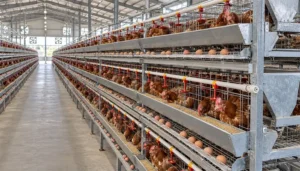
Conventional cages confine hens in compartments; enriched cages add resources such as nests and perches. Those additions do not remove all restrictions. Cage design, usable space and resource access remain important differences between systems.
For equipment comparison, A-type layer cage systems e H-type layer cage systems describe structural arrangements. Neither name establishes that a system is enriched, meets a particular welfare standard or is accepted by the intended egg buyer. Obtain a detailed specification before selecting either arrangement.

Cage-Free Barn and Aviary Systems
Cage-free hens are not confined in cages, although they may remain indoors. Aviaries provide multiple levels within the house. Their layout must account for movement between levels and access to nesting, resting, feeding and drinking areas.
Buyers considering commercial multi-tier aviary systems should ask for a drawing showing bird movement and staff access. Usable space and accessibility deserve as much attention as the number of equipment tiers.
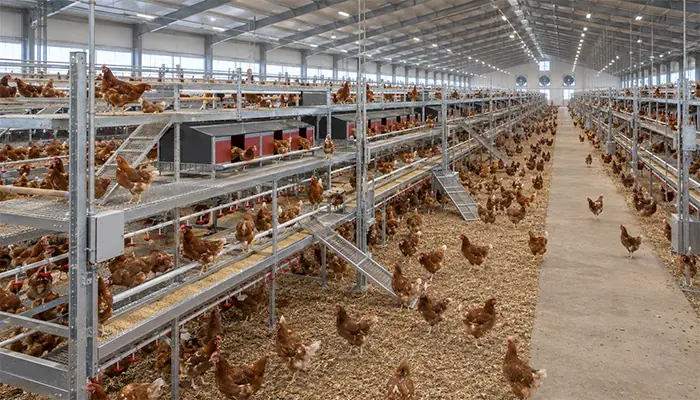
Free-Range and Organic Production
Free-range production provides outdoor access alongside the relevant housing arrangements. Organic production involves an additional set of production and certification requirements. The exact conditions depend on the market and scheme, so the two labels should not be treated as interchangeable.
For a purchasing decision, request the actual standard the project must meet. A product description using “organic,” “European standard” or “welfare-friendly” does not replace that specification.
Are Chicken Farms Cruel to Chickens?
Some chicken farming practices cause substantial suffering. Recognising that does not require assuming every farm has identical conditions. A useful assessment asks what the birds can do, whether they experience pain or distress, and which problems the system prevents or creates.
Good management can address equipment faults and poor care. It cannot create opportunities for natural behaviour where the housing offers no space or resources for those behaviours. That is why both system design and daily management deserve scrutiny.
Restricted Movement and Natural Behaviour
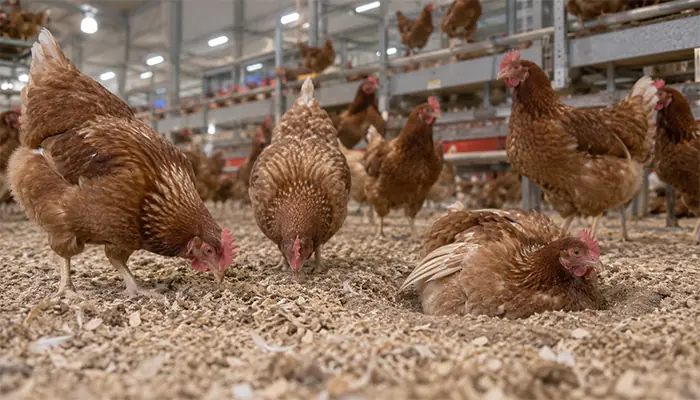
Chickens have behavioural needs beyond eating and drinking. Confinement can limit movement, foraging and comfort behaviours. For laying hens, nesting and access to appropriate resting structures also matter.
The EFSA scientific opinion on laying hen welfare identifies restriction of movement, impaired behaviour and injuries among relevant concerns, and recommends non-cage housing with appropriate resources. It also discusses the welfare costs of beak trimming and injurious pecking. These are scientific findings and recommendations, not a statement that every country has the same law.
Fast Growth and Broiler Health
Fast growth can be associated with welfare problems in meat chickens, including impaired movement. Assessing a broiler flock therefore requires attention to the birds themselves as well as growth and feed performance.
The EFSA assessment of broiler welfare examines genetic selection alongside housing and management hazards, including locomotory disorders, heat stress and restricted behaviour. Its findings support considering the strain and production system together. Simply changing one piece of equipment does not resolve every risk associated with the chosen production model.
Living Conditions and Daily Care
When reviewing chicken living conditions, ask what happens throughout the house and over time. Is one end consistently harder to manage? Do faults recur after a repair? Can staff reach and inspect every group of birds? An isolated inspection photograph may miss these patterns.
Likewise, a description such as cage-free or free-range does not establish that every aspect of care is adequate. These labels describe important features of a system; they do not substitute for examining its operation.
Catching, Transport and Slaughter
Welfare concerns continue when birds leave the farm. Catching and loading need coordination with transport so that delays and handling problems can be addressed. For meat production, slaughter may occur at a dedicated processing plant or, in some operations, on the farm.
The EFSA review of poultry slaughter identifies risks during handling, restraint, stunning and bleeding. Effective stunning, monitoring and trained staff are central welfare considerations. Processes and legal requirements vary, so neither “processed commercially” nor a particular production label guarantees that suffering has been prevented.
Measuring Welfare Rather Than Assuming It
The WOAH chapter on broiler production systems calls for assessment using outcomes alongside the resources and design provided. Examples include gait, injuries, disease, behaviour and mortality records.
For the farm manager, the practical question is whether observations lead to action. Records should identify a problem, prompt investigation and show whether the response helped. A high egg total or a low equipment failure rate answers a different question and should not replace welfare assessment.
How Can Commercial Chicken Farms Improve Animal Welfare?
Start with the Production Brief
Write down the intended bird type, housing approach and buyer requirements before requesting quotations. Include the welfare outcomes the project wants to monitor. This gives designers something more useful than a capacity target alone.
If the proposed system cannot provide a required resource or meet the intended buyer’s specification, address that mismatch before construction. Later adjustments may be costly or physically difficult.
Check Whether Resources Are Actually Accessible
A drawing should make clear how birds reach feed, water and other relevant resources. Ask the supplier to explain those routes and demonstrate how staff will inspect them. Include the rearing stage in the discussion rather than looking only at the adult production house.
During operation, use observations to test whether the layout works as intended. The presence of a resource is only the starting point; its condition and accessibility also need attention.
Combine Automation with Human Responsibility
Automation can organise routine work and make changes easier to detect. Its value depends on appropriate settings, maintenance and response. An alarm that nobody receives is not an effective management tool.
Ask who checks sensors, how a failed motor is identified and what happens during an outage. Keep responsibilities clear across shifts, including weekends. These are practical purchasing questions as well as operating decisions.
Make Improvement Part of the Operating Routine
Give staff a clear way to report concerns and record corrective work. Review recurring problems with the people who inspect the house, rather than relying only on summary production figures.
Sustainable chicken farming also involves resource use and environmental management. These objectives should be considered alongside welfare. A proposal that saves electricity or reduces labour still needs a separate explanation of how it affects the birds.
What Should Buyers Check Before Choosing Poultry Farm Equipment?
A useful quotation connects equipment to a specific farm. Before comparing prices, give suppliers the same project information and request an equivalent scope of supply. Otherwise, a lower price may simply exclude installation, controls, spare parts or essential building work.
- Birds and production: Specify broilers, layers or breeders, the intended strain and production stages.
- Market requirements: Identify applicable housing, welfare and buyer specifications.
- Building and services: Provide dimensions, climate conditions, water supply and electrical arrangements.
- Usable layout: Request resource locations, inspection routes and maintenance clearances.
- Emergency arrangements: Clarify alarms, backup provisions and manual response procedures.
- Operating costs: Compare staffing needs, consumables, servicing and replacement parts.
- Handover: Agree on installation responsibilities, training, documentation and commissioning checks.
Ask suppliers to explain assumptions behind the quoted capacity. If the answer depends on a bird size, configuration or local operating condition, that assumption belongs in the proposal. Written details make it easier to compare offers and identify gaps before placing an order.
For example, two quotations may describe a house for the same number of layers but include different services. One may cover only the cage structure, while another includes feed delivery, egg collection, manure removal and controls. Compare the scope line by line, then examine the proposed layout. Neither a larger package nor a lower unit price establishes that the design is suitable for your flock.
A practical review meeting should include the farm manager, the building designer and the equipment supplier. Walk through a normal working day on the drawing: feed delivery, inspection, egg handling, cleaning and maintenance. Then walk through an interruption, such as a pump or power failure. This exercise often reveals unclear responsibilities and missing access space before they become problems on a working farm.
Frequently Asked Questions About Chicken Farming
What Is the Difference Between Chicken Farming and Poultry Farming?
Chicken farming focuses on chickens. Poultry farming also covers other domesticated birds, including ducks and turkeys. Within chicken farming, broilers, layers and breeders have different production roles, so their equipment and management requirements should be specified separately.
Are All Commercial Chickens Raised in Cages?
No. Commercial production includes floor-based housing, cage systems and cage-free barns or aviaries, with or without outdoor access. “Commercial” describes production for a market; it does not identify one housing arrangement. Ask how the birds are housed rather than inferring it from farm size.
Is Cage-Free the Same as Free-Range?
No. Cage-free means birds are not confined in cages; they may live entirely indoors. Free-range includes outdoor access under the applicable production rules. Organic is a separate production designation with additional requirements. For procurement, check the relevant scheme rather than relying on the label alone.
How Long Are Chickens Raised on a Farm?
The answer depends on their purpose, strain and market. Broilers are raised to a target meat-production stage, while laying hens remain in production over a much longer period. Use the chosen strain’s guidance and the farm’s production plan when calculating feed, space and replacement schedules.
How Are Chickens Killed for Food?
Commercial processing commonly involves stunning followed by bleeding, although methods and legal provisions differ. Welfare depends on effective procedures, handling and verification, not simply the name of the method. The slaughter section above links to an assessment of these risks and control measures.
Can Large Chicken Farms Improve Animal Welfare?
Yes, improvements are possible through changes to housing, flock choices, care and monitoring. However, a large budget or automated equipment does not prove good welfare. The relevant test is what changes for the birds, including whether the system allows important behaviours and addresses avoidable suffering.
Planning a Chicken Farm with Welfare in Mind
Understanding how chicken farms operate makes equipment decisions more concrete. The right questions connect the birds, the building, daily work and the market the farm intends to supply. Welfare belongs in those discussions from the beginning.
For a new poultry project or an upgrade, discuss your poultry farm layout with Sheedoz. Share your bird type, target capacity, house dimensions, project location and applicable buyer requirements so the equipment discussion can address the conditions of your farm.

 PT
 EN
 ES
 FR
 AR
 DE