
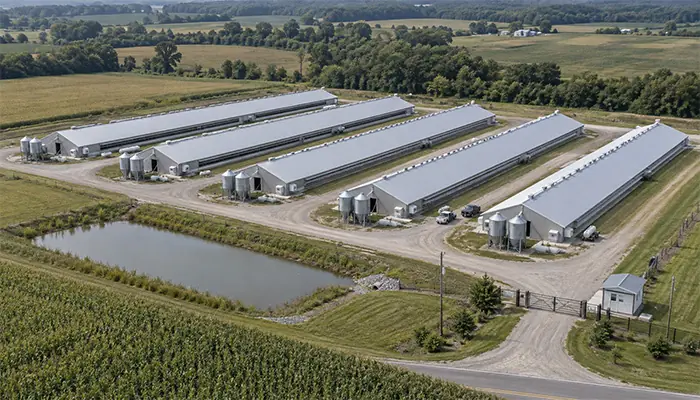
Poultry farming becomes problematic when the demands of birds, workers, the surrounding environment, and the business are difficult to balance. Disease outbreaks, restricted natural behaviors, manure pollution, unsafe working conditions, and unstable operating costs can all affect a farm’s performance.
These problems have different causes. Some develop when housing or daily management falls short. Others relate to the limitations of a particular production system, including how much freedom birds have to move and express natural behaviors.
For commercial poultry farmers, understanding these differences helps guide decisions about flock size, buildings, equipment, staffing, and markets. This guide examines the main concerns in poultry farming and explains what farm owners and equipment buyers should assess before starting or expanding a project.
1. What Is Poultry Farming?
Was ist eine Geflügelfarm?
Poultry farming is the raising of domesticated birds for eggs, meat, or breeding. A poultry farm is the site where that activity takes place. Poultry agriculture includes chickens, ducks, turkeys, and other farmed birds; this article focuses on commercial chicken production.
Layers, Broilers, and Breeder Flocks
Layers are hens raised primarily for table eggs. Broilers are chickens raised for meat. Breeder flocks produce fertile eggs that hatch into the next generation of birds.
Each production purpose requires different management. An egg farm must accommodate laying behavior and egg handling, while a broiler operation plans around growing birds and flock turnover.
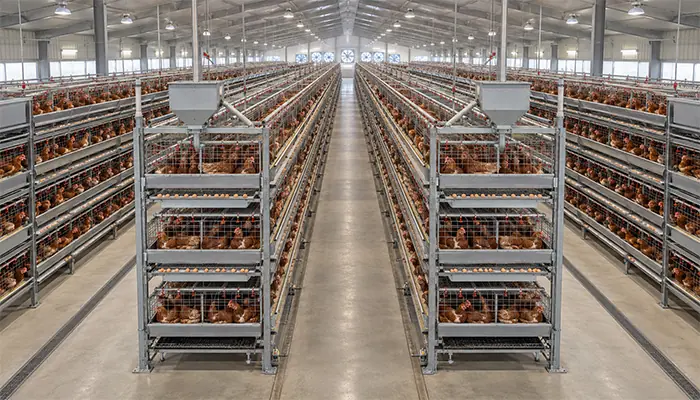
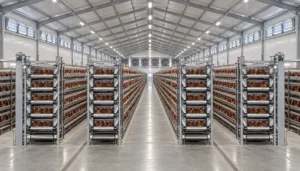
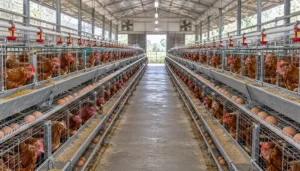
Housing options also differ. Our guide to battery cage systems explains cage arrangements, equipment functions, and the questions buyers should ask when evaluating layer housing.
2. Why Is Poultry Farming So Problematic?
Disease Outbreaks and Biosecurity Gaps
Disease is a serious concern because birds share buildings, equipment, water systems, and working routines. Pathogens can enter through infected birds, contaminated materials, personnel movements, or contact with wild birds and pests.
An outbreak may affect bird health, interrupt production, and create costs beyond the immediate loss of a flock. Cleaning, downtime, and delayed restocking can also disrupt the business.
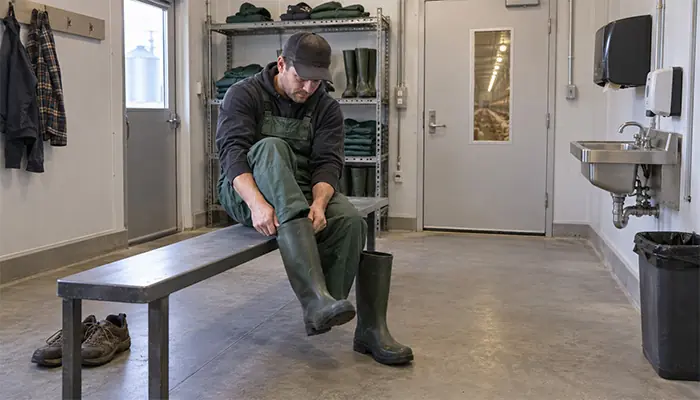
The WOAH guidance on poultry biosecurity emphasizes prevention of pathogen introduction and spread. A farm therefore needs clear entry controls, cleaning procedures, flock records, and veterinary oversight.
Animal Welfare and Restricted Natural Behaviors
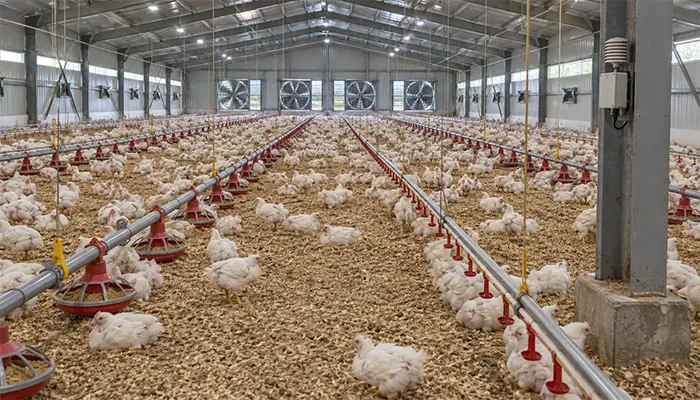
Animal welfare concerns include pain, injury, fear, discomfort, and restrictions on behaviors that matter to birds. Laying hens need opportunities for activities such as nesting, perching, and foraging. Broiler welfare requires attention to movement, resting conditions, and leg and foot health.
A productive flock can still experience welfare problems. Egg output or growth alone provides an incomplete picture of how birds are coping with their environment.
FAO’s review of poultry welfare explains why health, behavior, and other welfare indicators must be considered together. Management can improve conditions, but it cannot fully remove restrictions built into a housing system.
Poor Air Quality, Heat Stress, and Housing Problems
Birds, drinking systems, litter, and manure contribute heat or moisture to the house. Poor ventilation allows unwanted heat, moisture, gases, and dust to accumulate. Conditions can also vary between aisles and equipment tiers.
As FAO’s poultry housing guidance explains, environmental management depends on the building, climate, and needs of the birds. Installing fans alone does not establish that air reaches every occupied area effectively.
Before construction or expansion, review the factors affecting chicken house design, including site conditions, layout, ventilation, utilities, and maintenance access.
Manure, Water Pollution, and Resource Use
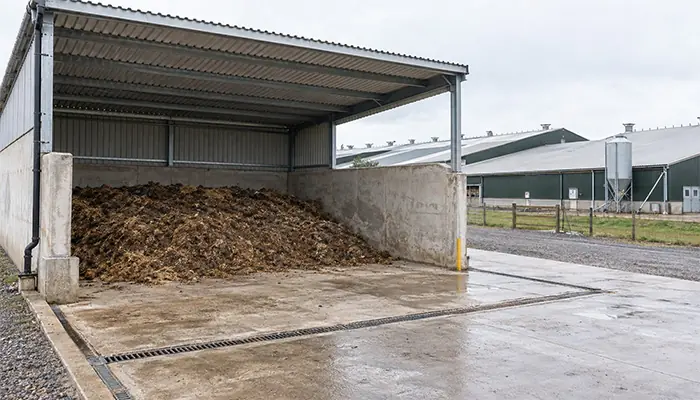
Poultry manure contains nutrients that can be useful in crop production. When storage, treatment, or land application is poorly managed, those nutrients can become pollutants.
Runoff and excessive nutrient application can affect surface water and groundwater. Odor, dust, and emissions also matter to neighboring communities. FAO’s poultry waste management review describes these environmental concerns.
Removing manure from a building is only one stage of the process. A project must also provide a suitable destination for the material. Feed sourcing, water consumption, electricity, transport, and waste handling all belong in the farm’s resource plan.
Food Safety Risks and Antimicrobial Resistance
Food safety concerns arise when harmful microorganisms contaminate eggs, meat, or the environments through which products move. Hygiene, flock health, collection practices, storage, and handling all require attention.
Antimicrobial resistance is a related but distinct issue. It develops when microorganisms no longer respond effectively to medicines. The World Health Organization identifies misuse and overuse of antimicrobials as major drivers.
Responsible poultry farming combines disease prevention with veterinary diagnosis and appropriate treatment. Farms should maintain treatment records and follow applicable medicine-use and withdrawal requirements. Necessary animal treatment should remain available under professional supervision.
Feed Costs, Labor Demands, and Market Pressure
A poultry business must pay for feed, birds, labor, utilities, maintenance, and other operating needs while managing changes in sales income. Equipment payments and infrastructure costs add further commitments.
For example, a quotation may appear affordable until the buyer adds installation, backup power, water storage, spare parts, and manure handling. A production plan can also become difficult to maintain if staffing or maintenance costs were underestimated.
Compare budgets using the same assumptions and equipment scope. Consider how the business would respond to higher feed costs, lower sale prices, or an interruption in production, rather than relying on a single favorable forecast.
3. How Does Factory Farming Affect Poultry?
What Does Factory Farming Mean in Poultry Production?
“Factory farming” is commonly used to describe highly intensive animal production. It is not a precise description of one chicken housing design.
Farm size, stocking density, automation, and housing type are separate characteristics. A large poultry farm may use cages, floor housing, or an aviary. Understanding the actual system is more useful than judging conditions from the label alone.
Welfare Concerns for Factory-Farmed Hens and Broilers
Conventional battery cages restrict movement and provide limited opportunities for several natural behaviors. Broiler production raises additional questions about growth, mobility, resting surfaces, and access to resources.
These concerns deserve a direct assessment when equipment is selected. A system that simplifies feeding or egg collection does not automatically satisfy birds’ behavioral needs.
For laying hens, EFSA’s welfare assessment recommends cage-free housing alongside suitable litter, resting structures, and measures to address injuries and other welfare problems.
How Housing and Management Change the Risk Profile
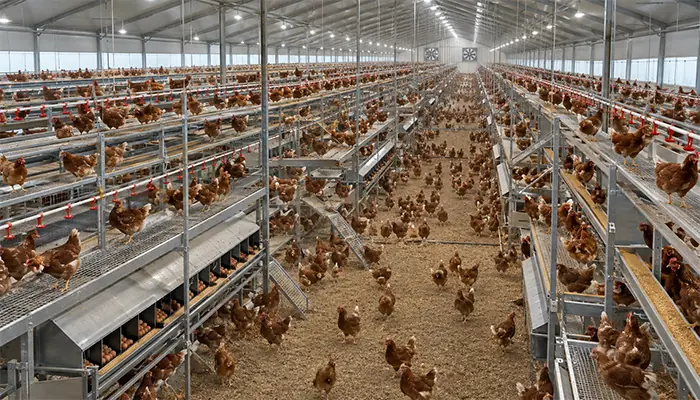
Cage-free housing provides greater opportunities for movement, but its layout and management still matter. Farmers must consider navigation between levels, access to nests and feed, litter condition, and flock behavior.
For projects considering this approach, commercial multi-tier aviary systems illustrate how several functions can be arranged within one house. Evaluate the complete proposed installation, including usable areas and staff access, against the project’s requirements.
4. What Does the Chicken Population Problem Mean for Farms?
Total Flock Size vs. Stocking Density
The phrase “chicken population problem” can refer to different concerns. For farm planning, a useful distinction is between total flock size and stocking density.
Total flock size describes how many birds are present. Stocking density describes how many birds, or how much live weight, occupy a defined usable space. Comparisons are meaningful only when the area and measurement method are clear.
Matching Bird Numbers to Farm Capacity
Every additional bird creates demands on housing and daily operations. Increasing capacity should trigger a review of feeding access, drinking provision, ventilation, manure handling, inspection routes, and staffing.
Ask suppliers to show the basis of their capacity figures on a layout drawing. Identify aisles, service spaces, and areas birds cannot use.
Our guide to what a chicken house should contain provides a useful starting point for reviewing these functions before equipment is ordered.
5. 5 Hazards of Poultry Farming for Workers
The following five groups describe common farm tasks and exposure routes. A site-specific assessment may identify additional hazards.
1. Exposure to Infected Birds and Contaminated Materials
Workers may encounter pathogens through sick birds, carcasses, secretions, or contaminated surroundings. The CDC’s guidance for reducing worker exposure to avian influenza recommends assessing tasks and combining suitable workplace controls with protective equipment.
Training should explain how to report unusual bird illness and how the farm responds.
2. Dust and Ammonia Exposure
Feed, feathers, litter, and dried manure can contribute airborne particles. Manure management also affects ammonia exposure.
Review ventilation and cleaning methods for the actual task. Protective equipment should be selected for the identified exposure; a dust mask does not provide the same protection as equipment intended for gases.
3. Disinfectant and Chemical Handling
Cleaning chemicals can create risks during dilution, application, storage, and disposal. Staff need access to product instructions, safety information, and suitable protective equipment.
Keep containers labeled and follow the specified mixing instructions. Cleaning performance and worker protection should be addressed in the same operating procedure.
4. Machinery, Electrical, and Slip Hazards
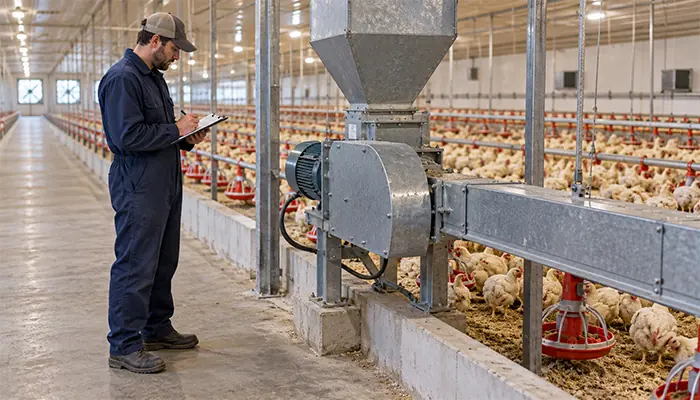
Feed conveyors, manure belts, fans, moving components, and electrical installations require safe access and maintenance arrangements. Wet floors and obstructed walkways create additional problems.
Include guarding, safe isolation procedures, drainage, and clear service routes in the equipment and building review.
5. Heat Stress and Manual Handling
Hot conditions, lifting feed bags, moving equipment, and repetitive tasks can place physical strain on workers.
Plan work around the environment and task demands. Mechanical handling aids, appropriate working heights, drinking water, rest arrangements, and training should be considered as part of normal farm operations.
6. How Can Poultry Farmers Reduce These Problems?
Build a Farm-Specific Biosecurity Plan
Translate general biosecurity principles into instructions staff can follow. Define who may enter, where visitors change footwear or clothing, how equipment is cleaned, and who receives reports of unusual illness.
Assign responsibility for checking that these procedures are followed. A written plan needs an owner and a practical place in the daily routine.
Match Stocking Density and Housing to Bird Needs
Evaluate the proposed housing with the bird supplier, equipment designer, and relevant animal-health advisers. Confirm the intended bird type, age range, usable space, and applicable housing requirements.
The layout should allow staff to observe birds and reach essential equipment. Capacity calculations should reflect the complete working installation.
Manage Ventilation, Drinking Water, and Manure Together
Treat these functions as a connected operating system. Investigate wet areas by checking drinkers, drainage, air movement, and the manure or litter routine together.
In suitable installations, poultry slatted floor systems allow droppings to pass below the standing surface. Buyers still need to evaluate foot support, openings, cleaning access, litter or activity areas where required, and how manure will be removed from underneath.
Train Staff and Prepare for Equipment or Power Failures
Before stocking the house, establish what happens if a critical fan, pump, feeder, controller, or power supply stops working.
Confirm the alarm response, backup arrangements, repair responsibilities, and essential spare parts. Practice the response with staff so that responsibilities are clear when a fault occurs.
Track Bird Health, Welfare, and Production Records
Record water and feed use, mortality, egg output or growth, visible injuries, and equipment faults. Review changes against the flock’s age and normal pattern.
Use these records to identify issues requiring investigation. A dashboard is useful only when someone checks the information and takes appropriate action.
| Concern | What to Check | Management Response |
|---|---|---|
| Uneven access to resources | Feeder and drinker distribution, bird behavior | Review layout and equipment adjustment |
| Persistent wet areas | Leaks, drainage, litter and manure conditions | Correct the source and review housekeeping |
| Difficult daily inspection | Aisles, visibility, access to tiers | Improve access and inspection routines |
| Recurring equipment faults | Service records, wear, parts availability | Address the cause and revise maintenance |
| Unclear operating costs | Items included in quotations and budgets | Compare the same scope and assumptions |
7. What Should Buyers Check Before Choosing Poultry Equipment?
Farm Layout, Capacity, and Market Requirements
Start with the production purpose, project location, house dimensions, planned flock size, and the requirements of the market that will buy the eggs or meat.
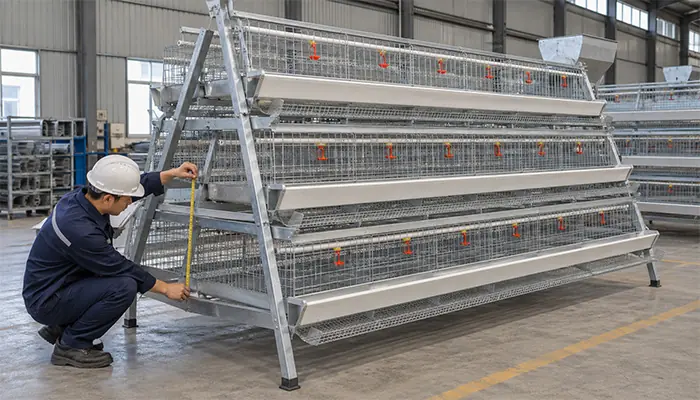
Vergleichen Sie A-type layer cage systems by reviewing the stepped arrangement, footprint, inspection access, and proposed handling systems.
Für H-type layer cage systems, examine the stacked tiers, building clearance, service access, ventilation distribution, and automation package. A-type and H-type describe structural arrangements; the names alone do not establish welfare compliance.
Cleaning Access, Materials, and Maintenance
Request drawings and material specifications. Inspect joints, exposed edges, doors, floor surfaces, corrosion protection, and components that require regular replacement.
Ask how workers will clean hard-to-reach areas or replace a damaged part after installation. Maintenance access should be demonstrated on the proposed layout.
Compatibility of Feeding, Drinking, and Manure Systems
Confirm which components are included and how they connect. A complete quotation should identify equipment capacities, utilities, controls, installation scope, and the interfaces with the building.
Follow the material flow through the project: feed entering the house, water reaching the birds, eggs leaving the system, and manure reaching its next destination.
Backup Systems, Spare Parts, and Technical Support
Ask what happens after commissioning. Establish warranty terms, operator training, troubleshooting support, parts availability, and expected service responsibilities in writing.
Compare the total cost of the installed and supported system. Equipment that the local team can inspect and maintain deserves careful consideration alongside automation features.
8. Frequently Asked Questions About Poultry Farming
Are Poultry Farming and Chicken Farming the Same?
Chicken farming is one part of poultry farming. The wider term also includes raising other domesticated birds, such as ducks and turkeys. Species and production purpose influence housing, equipment, feeding, and management requirements.
Why Are Disease Outbreaks a Concern for Poultry Farmers?
Birds share resources and working environments, while people, equipment, and supplies move between locations. These connections can provide routes for infection. Prevention, monitoring, and timely veterinary investigation help farms manage the risk.
Does Cage-Free Farming Eliminate Welfare Problems?
Cage-free housing expands opportunities for movement and behavior. Farmers must still manage injuries, flock interactions, litter, resource access, and environmental conditions. Welfare should be assessed through the birds’ condition and behavior as well as the equipment provided.
Can Automation Solve Poultry Farming Problems?
Automation can support feeding, egg collection, manure handling, and monitoring. It also requires maintenance, reliable utilities, and trained operators. Its value depends on how well the equipment fits the project and how effectively the farm manages it.
What Should a Poultry Farmer Improve First?
Start with a site assessment. Address immediate problems affecting bird health, access to feed and water, environmental conditions, or worker safety. Then prioritize recurring problems using flock records, staff observations, and technical advice.
Can Poultry Farming Become More Sustainable?
Improvements can include more efficient resource use, better manure management, reduced losses, and stronger animal-welfare practices. Progress should be measured across several outcomes, including effects on birds, workers, neighboring communities, and the farm’s operating stability.
9. Planning a Better Poultry Farm
Poultry farming requires decisions that work together over the life of a flock and the life of the business. Housing, bird numbers, equipment, staffing, and waste handling should be planned as one project.
Sheedoz offers layer cage and cage-free equipment options for commercial poultry projects. To discuss a suitable configuration, request a poultry house layout and equipment proposal.
Share your project country, production purpose, planned flock size, house dimensions, local climate, electricity conditions, and preferred level of automation. These details provide the basis for a more useful technical discussion and quotation.
 DE
DE  EN
EN  ES
ES  FR
FR  AR
AR  PT
PT