
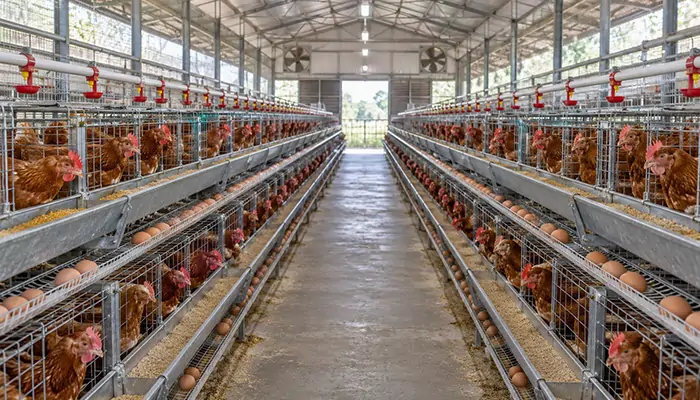
Battery cages are widely associated with commercial egg production. For poultry farm owners and equipment buyers, choosing a system requires more than comparing bird capacity. Cage design, house conditions, animal welfare requirements, and operating costs all affect the decision.
جدول المحتويات
تبديلWhat Are Battery Cages?
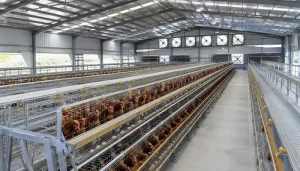
Battery cages are adjoining enclosures arranged in rows and often multiple tiers to house chickens, particularly laying hens. “Battery” describes the grouped arrangement, not a power source.
A battery hen is a hen kept in this housing system; it is not a chicken breed. Battery eggs refer to eggs produced by these hens. Conventional battery cages and enriched cages should be distinguished: enriched systems include features such as nests and perches.
How Does a Battery Cage System Work?
A layer cage system combines bird housing with feeding, drinking, egg collection, and manure handling. Sloped floors allow eggs to roll toward a collection area, while manure passes through the mesh floor.
Depending on the equipment package, feeding, egg collection, and manure removal may be manual or automated. Reliable ventilation, water supply, and daily inspection remain essential.
A-Type vs. H-Type Layer Cages
A-type layer cages use a stepped arrangement. Buyers should assess floor space, access for inspection, and the proposed manure removal method.
H-type layer cages use vertically stacked tiers. Compare their automation options, maintenance access, and compatibility with the poultry house.
A-type and H-type describe frame layouts. Neither term alone establishes welfare compliance or whether a cage is enriched.
Battery Cage Dimensions and Capacity
There is no single standard chicken battery cage size suitable for every project. Ask suppliers to distinguish individual compartment dimensions from the complete cage unit and installed system.
Check:
- Internal cage dimensions and usable floor area.
- Planned bird numbers and applicable space requirements.
- Feeder access, drinker provision, and cage door openings.
- Mesh quality, corrosion protection, and structural strength.
- Aisles, service areas, and available building height.
Do not accept a capacity figure without understanding its basis.
Benefits, Limitations, and Welfare
Cage systems can organize feeding and egg collection, use vertical space, and support mechanized manure handling. Actual labor savings depend on equipment and management.
Conventional cages restrict movement and natural behaviors. Bone health, equipment failures, and environmental control also need attention. Evaluate local housing rules and customer purchasing policies before investing.
Choosing a Supplier
Compare quotations with the same equipment scope. Confirm whether feeding, drinking, egg collection, manure removal, controls, installation, and spare parts are included.
Request layout drawings, material specifications, warranty terms, and comparable project references. Consider freight, energy, maintenance, and supporting infrastructure alongside the cage price.
Planning a layer farm? Contact Sheedoz with your project location, flock size, poultry house dimensions, and automation requirements to discuss equipment options and request a quotation.
 AR
AR  EN
EN  ES
ES  FR
FR  PT
PT  DE
DE