
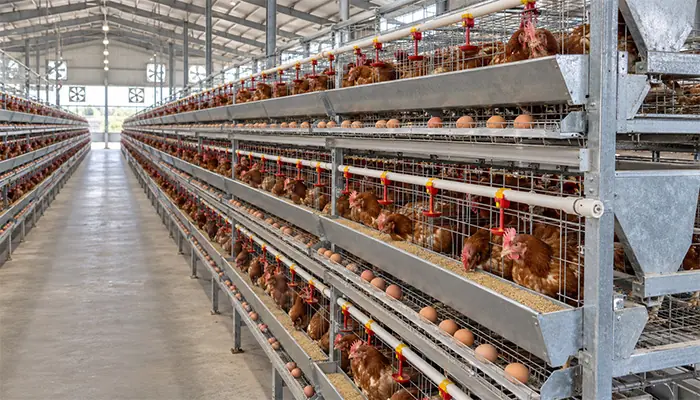
Hens are kept in cages on some commercial egg farms to organize feeding, drinking, egg collection and manure removal within a managed housing system. Cage layouts can also support the use of building space and the integration of automated equipment. These operational reasons explain why farms consider cages, but they do not remove the welfare concerns associated with confinement.
For an egg producer, the housing decision affects more than equipment cost. It influences daily work, bird management, maintenance and the markets the farm can supply. This guide explains why hens are put in cages, how different systems work, and what commercial buyers should evaluate before choosing laying hen housing.
What Are Laying Hen Cages?
Laying hen cages are compartments designed to house hens during egg production. They are installed inside a poultry house, with access to feed and water and a means of collecting eggs and handling manure. A commercial installation normally consists of rows of compartments rather than a single chicken in a cage.
The cage is only one component of the farm. Building design, ventilation, lighting, water supply and daily flock care all need to be planned alongside it. A purchase decision based only on the cage frame leaves important parts of the project unresolved.
It is also important to distinguish bird categories. Laying hens produce eggs, pullets are young females being reared for the laying flock, and broilers are raised for meat. These groups have different management needs. Equipment intended for adult layers should not automatically be treated as suitable for chicks.
To see the equipment offered for commercial egg production, explore Sheedoz’s laying hen cage systems. When requesting a proposal, specify the bird category and production stage.
Why Do Commercial Egg Farms Keep Hens in Cages?
The main reasons involve organizing work and integrating equipment. FAO’s discussion of poultry housing describes how cage installations can combine feeding, watering, egg collection, manure removal and environmental control. The practical value of each feature depends on the actual farm design.
Organized Feeding and Drinking
Feed troughs and drinking points serve defined groups of birds. Staff can follow a planned route to check the supply, while automated equipment can distribute feed along the rows. Farms should still verify access and operation rather than assuming that installed equipment guarantees every hen receives what she needs.

Accessible Egg Collection
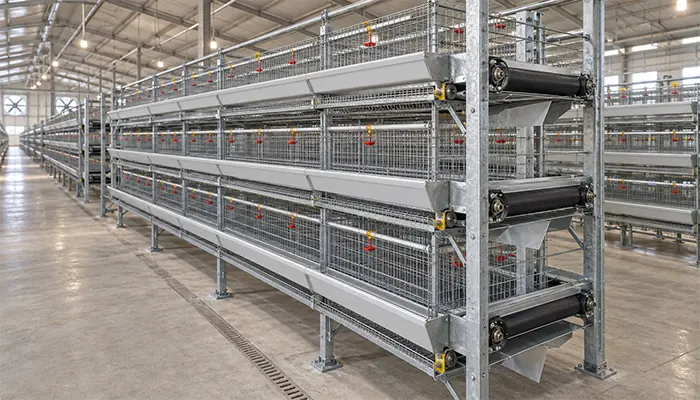
In conventional layer cages, the floor is designed to let eggs roll toward a collection area. Eggs may be gathered manually or transported by a belt. This creates a collection route that can connect with the farm’s egg-handling area.
For a buyer, useful questions include where eggs leave each row, how they transfer between conveyors, and how staff reach the collection equipment for inspection.
Separation from Accumulated Manure
Droppings pass through the cage floor to a collection area or manure-handling system below. This arrangement separates birds and eggs from much of the accumulated manure. Removal still needs to be scheduled and managed; manure remaining in the building cannot be ignored simply because it is beneath the cages.
Use of Building Space
Tiered cage arrangements use the height of the house as well as its floor area. That makes building dimensions an important part of equipment selection. However, installed capacity must be evaluated together with usable space per bird, access routes and the house’s environmental capacity.
Integration of Routine Tasks
Automation can connect several daily operations within one installation. Before comparing proposals, identify which tasks will be automated and which will remain manual. A quotation for cage frames alone is different from a quotation covering feeding, drinking, egg collection, manure removal and controls.
These are management reasons for using cages. They should be assessed alongside the welfare limitations and market requirements discussed below.
What Types of Hen Cages Are Used?
Chicken cages can be classified by their welfare features, physical arrangement and automation level. These descriptions answer different questions and should be kept separate when comparing products.
Conventional Battery Cages
Conventional battery cages are unfurnished compartments arranged in repeated rows or tiers. They provide basic feeding, drinking and egg collection facilities but lack the nesting, perching and litter facilities associated with furnished housing.
Enriched or Furnished Cages
Enriched cages include additional features such as nests, perches and a litter area. The required features and space depend on the applicable rules and specifications. They remain cage systems, so adding furnishings does not make the housing cage-free.
A-Type Layer Cages
A-type cages use a stepped arrangement, with tiers positioned on an A-shaped supporting structure. Sheedoz’s A-type layer cage system is presented with feeding, drinking, egg collection, manure removal and environmental-control equipment.
For a project comparison, request the complete installed width, working-aisle dimensions and equipment scope. Those details make the proposal more useful than the cage compartment dimensions alone.
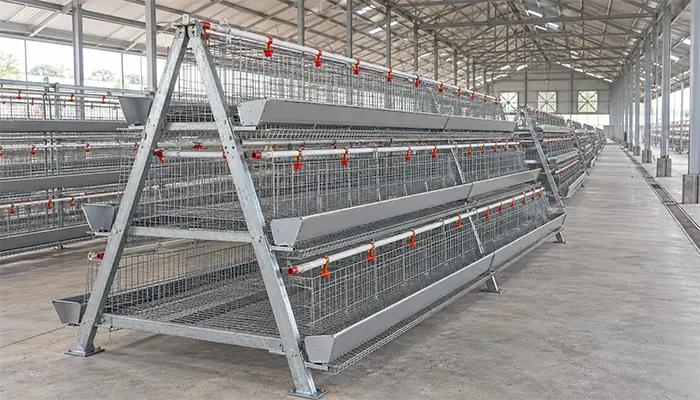
H-Type Layer Cages
H-type cages use vertically stacked tiers. Sheedoz’s H-type layer cage system combines this arrangement with automated farm equipment.
Ask how workers will inspect each level and reach the equipment for servicing. Review the total height against the building, and confirm the space required at the ends of the rows.
A-type and H-type describe the cage layout, not a welfare classification. Neither term alone establishes that a system is enriched or meets the requirements of a particular country or egg buyer.
What Are the Welfare Concerns for Caged Hens?
Confinement limits hens’ opportunities to move and perform natural behavior. Conventional cages provide limited scope for activities such as nesting, perching, scratching and foraging. Furnished cages provide additional facilities, but movement remains restricted.
Welfare assessment should consider the birds themselves as well as the equipment. Relevant observations include plumage damage, wounds, mortality and bone injuries. A cage description or an automation package cannot establish welfare outcomes on its own.
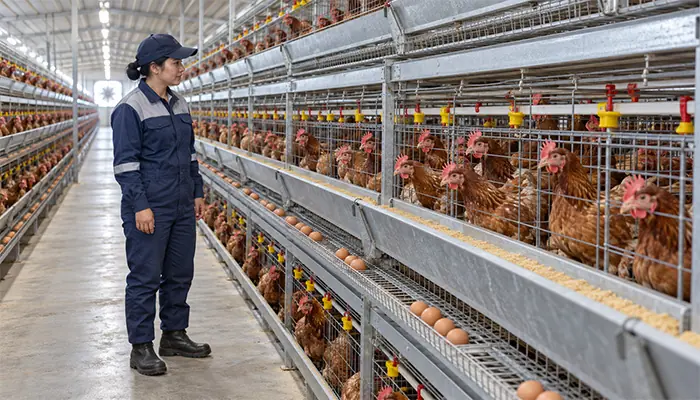
In its 2023 assessment of laying hen welfare, the European Food Safety Authority recommended cage-free housing, together with measures supporting behavior and monitoring bird condition. This is scientific advice, which must be distinguished from the legal requirements applying to an individual farm.
For an investment decision, ask what behavioral opportunities the proposed housing provides and how bird condition will be assessed throughout the flock cycle.
Caged, Cage-Free and Free-Range Hens: What Is the Difference?
The key distinction is how the birds are housed and where they can move. Cage-free housing does not necessarily provide access outdoors, while free-range production includes outdoor access.
| Système de logement | Basic arrangement | Accès à l'extérieur | Project focus |
|---|---|---|---|
| Conventional cages | Hens housed in unfurnished compartments | Not inherent to the system | Space, welfare restrictions and market eligibility |
| Enriched cages | Cage compartments with additional behavioral facilities | Not inherent to the system | Required furnishings, dimensions and applicable rules |
| Cage-free barn or aviary | Hens move within the indoor housing area | Not necessarily | Nests, litter, perches and flock management |
| Free-range | Indoor housing combined with access to an outdoor range | Yes, subject to the production requirements | Indoor facilities and outdoor-range management |
In a barn system, birds move within the house and use feeding, drinking, nesting and resting facilities. A multi-tier aviary also uses elevated structures, allowing hens to move between different areas. Hy-Line’s alternative-systems guidance distinguishes these arrangements from housing with access to an outdoor range.
Farms considering indoor cage-free production can review Sheedoz’s commercial multi-tier aviary systems and request a layout suited to their building and market requirements.

For comparison, use the same target flock size and the same list of included services. Review building modifications, staff training, maintenance and buyer acceptance alongside the initial equipment price. This creates a clearer basis for a decision than comparing headline capacity alone.
What Are Caged Eggs?
Caged eggs are eggs produced by hens housed in cages. The term describes the housing system. It does not, by itself, establish the eggs’ freshness, food safety or nutritional value.
For a commercial producer, the useful question is whether the intended customer accepts eggs from the proposed housing system. Ask prospective buyers for their written sourcing requirements before committing to equipment.
Keep housing claims separate from product-quality claims in sales documents. If a customer requires cage-free eggs, a cage installation does not become eligible merely because it has automated equipment or a higher specification frame. The housing arrangement must match the customer’s requirement.
How Do Feeding, Egg Collection and Manure Systems Operate?
Sheedoz’s layer equipment pages describe feeding, drinking, egg collection, manure removal and environmental control as components of an integrated installation. Buyers should ask for a written description of each component and its connection to the rest of the farm.
Feeding and Drinking
Confirm the route from feed storage to the troughs and the route from the water supply to the drinkers. Request operating instructions, adjustment procedures and the checks staff must perform. Also ask which filters, regulators and other service items are included in the quotation.
Egg Collection
Review the complete path from the collection belt to the receiving area. Ask about conveyor transfers, access for cleaning, spare parts and compatibility with any existing grading or packing equipment. Where capacity figures are quoted, ask what operating conditions those figures assume.

Enlèvement du fumier
Identify where manure is collected and where it goes after leaving the building. Confirm whether the proposal includes only the equipment inside the house or also the discharge conveyor and receiving arrangements. Assign responsibility for the downstream storage or handling plan before installation.

Environmental Controls and Emergency Planning
Review the ventilation and control package as part of the complete house. Ask what sensors and alarms are included, how they are tested, and who responds when an alarm is triggered. Request a plan for essential services during a power or water interruption.
A practical handover should include operator training, maintenance instructions, commissioning checks and a spare-parts list. Record these items in the purchase agreement so that “automatic system” has a clear meaning for both parties.
How Should a Commercial Farm Choose Laying Hen Housing?
Start with the farm’s intended market and operating conditions, then compare equipment proposals. The following sequence can help buyers turn a general product inquiry into a project specification.
1. Confirm the Country and Egg Sales Requirements
Check applicable housing rules and obtain the egg buyer’s requirements. Under the EU laying-hen framework, non-enriched cages have been prohibited since 1 January 2012. This does not mean that every cage type is prohibited everywhere; country-specific requirements and the rules applying to the establishment still need to be checked.
Include the intended housing category in the project brief. Ask the supplier to document how the proposed design addresses the relevant requirements.
2. Define the Flock and Building
Provide the target bird number, bird strain, building length, width and clear height. Include column positions, doors and existing service areas. Request a drawing showing rows, aisles, inspection access and equipment at both ends of the house.
Ask the supplier to explain how the proposed capacity was calculated. Distinguish capacity per compartment, per set and per complete house, and check the usable space assigned to each bird.
3. Agree on the Automation Scope
List the operations you want automated. Confirm whether feed storage, delivery equipment, water treatment, egg conveyors, manure discharge equipment and environmental controls are included. Mark optional items separately to make quotations comparable.
4. Review Operating and Maintenance Responsibilities
Identify the people responsible for flock inspection, equipment operation and repairs. Ask what training they will receive and which tasks require specialist support. Review access to replacement parts and the information needed when requesting service.
5. Compare the Complete Installed Cost
Build a comparison covering equipment, freight, import charges, site preparation, installation and commissioning. Add estimated operating expenses using local prices and project assumptions. Request clarification where a quotation leaves responsibility unclear.
A lower cage-frame price may come with a different equipment scope. Compare equivalent proposals before deciding which offers the better fit for your farm.
FAQ
Why Are Hens Put in Cages?
Some farms use cages to organize feeding, drinking, egg collection, manure handling and the use of building space. The decision must also account for welfare limitations, applicable rules and egg-buyer requirements.
Can Hens Lay Eggs Without Cages?
Yes. Hens can produce eggs in cage-free barns, aviaries and free-range systems. These arrangements use nesting facilities and management practices suited to their housing design.
Are All Chicken Cages the Same?
No. Compare the intended bird category, compartment design, welfare features, row arrangement and automation scope. A-type or H-type alone does not describe all of these characteristics.
Is Cage-Free the Same as Free-Range?
No. Cage-free hens can move within their indoor housing area. Free-range systems also provide outdoor access under the relevant production requirements.
How Many Hens Can Be Kept in One Cage?
There is no single figure for every cage. The answer depends on the design, usable area, bird needs and applicable requirements. Obtain the manufacturer’s capacity calculation and check it against the requirements for your project.
Can Chicks Be Kept in Adult Laying Hen Cages?
Chicks need age-appropriate brooding conditions and access to suitable feeding and drinking equipment. They should not be placed in adult layer equipment without a suitable rearing design. Sheedoz offers baby chick and brooder cage equipment for buyers evaluating the rearing stage.
Do Cage Systems Prevent Disease?
Cages do not make a farm disease-free. Housing must be supported by a biosecurity and flock-health program. Hy-Line’s guidance emphasizes controlling how pathogens enter the farm and cleaning between flocks.
Are Laying Hen Cages Legal Everywhere?
No single answer applies to every country and housing category. Confirm the rules at the farm location and the sourcing conditions imposed by the intended egg customers before purchasing equipment.
Choose Hen Housing Around the Farm and Its Market
Hens are kept in cages on some egg farms because the arrangement supports organized production tasks and equipment integration. Understanding those reasons is the starting point for evaluating a system, alongside its welfare limitations and suitability for the intended market.
For a commercial project, define the required housing category, flock size, building dimensions and automation scope before seeking a final quotation. Use a complete layout and equipment list to evaluate how the installation will operate.
Planning a new layer farm or upgrading an existing house? Contact Sheedoz for a poultry equipment proposal and share your country, target flock size, house dimensions and preferred housing system. These details give the team a clearer basis for discussing your project.

 FR
 EN
 ES
 AR
 PT
 DE